
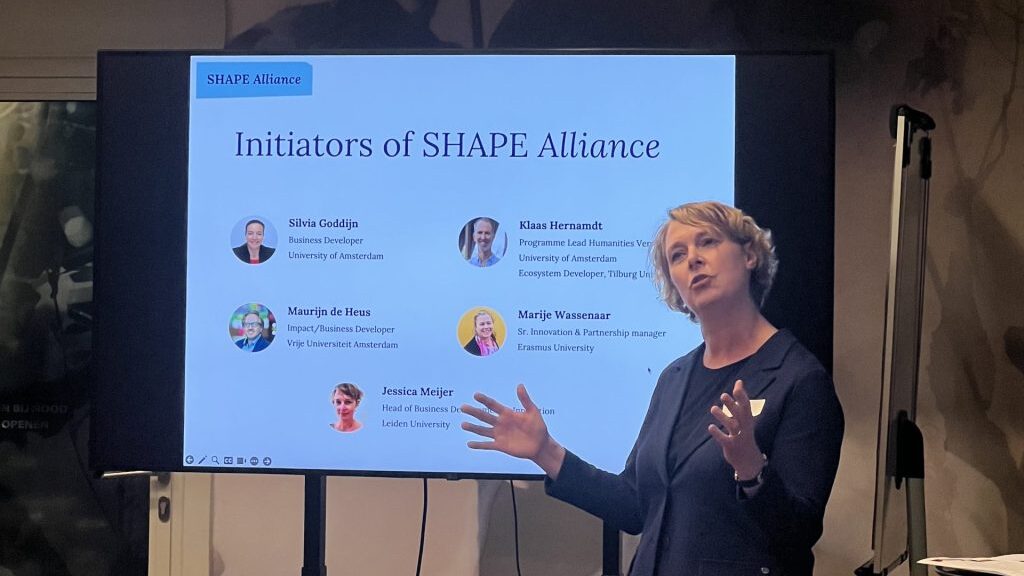
The Netherlands won’t manage without the contributions of the social sciences, humanities, and the arts. That is what the founders of the Dutch SHAPE Alliance state.
SHAPE Alliance NL is a national network that, since October 30, 2025, has been sharing best practices in value creation and societal impact of SHAPE (Social Sciences, Humanities and Arts research for People, Economy, and Environment) among university professionals, researchers, and stakeholders. Its goal is to further enhance the positive contribution of SSHA (the social sciences, humanities, and arts domain) to society.
We spoke with two founders of the SHAPE Alliance team: Klaas Hernamdt, program leader at the Humanities Venture Lab (University of Amsterdam) and ecosystem developer (Tilburg University), and Jessica Meijer, head of Business Development & Innovation (Leiden University). What is the future of SHAPE in the Netherlands?
What is SHAPE?
The acronym SHAPE was initiated in 2020 by professor Julia Black, former president of the British Academy, to emphasize the value and relevance of the social sciences, humanities, and the arts, and to place them on equal footing with Science, Technology, Engineering, and Maths (STEM) in terms of value and impact. She observed that while the impact of SSHA is significant, it is sometimes less visible.
What is the SHAPE Alliance?
The SHAPE Alliance is a knowledge partner for SSHA-impact in the Netherlands, based at universities. According to the five founders, SSHA knowledge is fundamental to positive societal change. SSHA disciplines foster and strengthen essential skills such as critical thinking, ethical reasoning, and understanding human behavior – skills that are indispensable for addressing challenges like climate change, public health, and social inequality. SSHA-expertise is therefore crucial for effective policy and innovation in these areas: real progress.
What does the SHAPE Alliance do?
The Alliance’s founders are building a network of experts to create a SHAPE-ecosystem for value creation. By connecting, guiding, and inspiring university Knowledge Transfer Offices (KTOs), impact professionals, researchers, and other professionals, they are professionalizing the SHAPE-ecosystem.
The SHAPE Alliance engages in exchanges of best practices with countries such as Sweden, the United Kingdom, and Denmark. They participate in (and host) workshops and symposia both within and outside the European Union.
The founders currently focus on four core tasks:
- Connecting: Strengthening community and capacity. Examples include showcasing best practices and providing improvised peer-to-peer advice.
- Changing: Offering guidance and training. Examples include training researchers in social entrepreneurship and supporting impact initiatives.
- Creating: Building social enterprises and impact projects. Examples include facilitating booster programs and access to funding.
- Coordinating: Aligning and advocating interests. An example is mapping the interests of KTO professionals and sharing them with stakeholders, both nationally and internationally.
Hernamdt and Meijer’s perspective on the future of SHAPE
According to Hernamdt, the upcoming Integrated Innovation Actionplan provides good opportunities to put SHAPE into practice in the Netherlands. The plan aims to involve SSHA-expertise early and integrally in innovations. Meijer adds that the Actionplan beautifully brings together the worlds of SHAPE and STEM: “…I worked in biotechnology for a long time. There, innovating and entrepreneurship were the norm. SSH-professionals, such as anthropologists, still often see themselves as either anthropologists or innovators. We are breaking down this traditional approach.”
Hernamdt emphasizes that the Wennink Report should be viewed in a broader context: “…technology is often fleeting and not always grounded in the Netherlands and Europe, risking acquisition by others. Our economy is largely a service economy, and we must not lose sight of the fact that the SSHA-domain contributes to making that economy innovative and successful.”
Meijer states: “…it is important that the government values the SHAPE movement, for example, with a ten-year plan and subsidies for programs, knowledge development, and implementation.” Hernamdt also hopes that the Netherlands will take the European momentum around SHAPE seriously, so as not to fall behind: “…forty years ago, there were no Technology Transfer Offices (TTOs), and now we benefit enormously from their value. Now is the time for SHAPE and value creation around SSHA-knowledge. In ten, twenty, or thirty years, we will reap the full benefits.”
Workshop ‘SHAPE – The Driver of European Competitiveness?!’
On April 16, 2026, the Alliance, together with partners, will organize a workshop in Amsterdam from 10:00 AM to 4:00 PM. The workshop ‘ ‘SHAPE – The Driver of European Competitiveness?!’’ will address the practical question: How do you secure the resources needed to realize SHAPE-valorization?
You can register here. Participants from the United Kingdom, Ireland, Germany, Denmark, Norway, Belgium, Austria, Poland, Egypt, and the Netherlands have already signed up.
Questions or suggestions? The SHAPE Alliance welcomes dialogue
Klaas Hernamdt: k.hernamdt@uva.nl
Jessica Meijer: j.meijer@luris.nl